Feeling Behind in Life? It Might Be a Lie
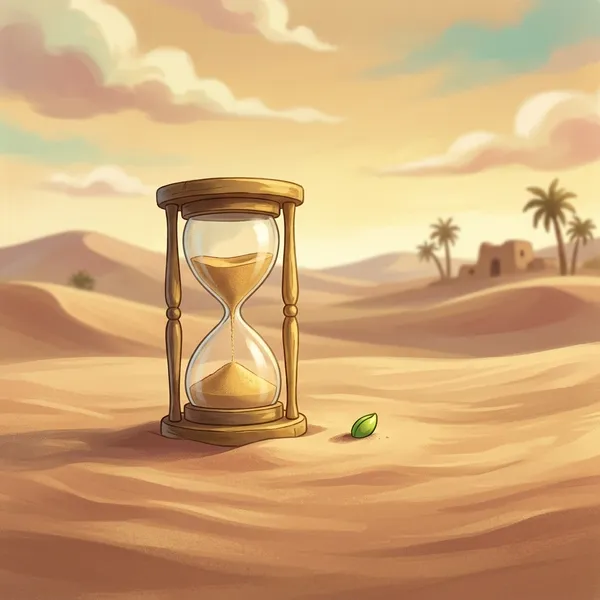
You open the app for thirty seconds and suddenly your chest is tight. Someone just announced the promotion. The baby. The ring. The house. And there you are, still in what feels like a waiting room with no number, watching the whole room get called ahead of you. That feeling of being behind in life is one of the most common aches people carry quietly. It is not that life is hard, exactly. It is that you are starting to wonder if you missed your slot.
That feeling has a name. And the name is a lie.
When feeling behind in life is really about God's clock
One preacher I heard describe it this way: there is God's timeline for your life, and then there is the enemy's counterfeit version of it, the one that tells you the window has closed, that you moved too slowly, that someone else lapped you and now there is no catching up. The lie does not come dressed as a lie. It comes dressed as math. Look around, it says. Everyone else is already there.
But God does not operate on that math.
The only one authorized to set the times and seasons of a life is the one who created times and seasons in the first place. That is not a bumper-sticker comfort. It is a structural claim. When Daniel praises God in the second chapter of his book, he says wisdom and power belong to God, that he changes times and seasons, that he reveals deep and hidden things. The timetable is not ours to draft. The pressure to keep up with someone else's schedule is pressure we were never meant to carry.
The striving trap (Abraham and Sarah tried it)
Here is what we do when we decide we are behind: we start pushing. We strive. We take things into our own hands because waiting, honestly, feels irresponsible. Surely God needs our help to catch us up.
Abraham and Sarah did this. God had promised Abraham a son, a line of descendants so many it would be like counting stars. The promise was real. But Sarah was barren and time kept moving and nothing was happening. So they decided to help it along. Sarah gave Abraham her servant Hagar. Hagar conceived. And then everything fell apart. The jealousy, the abuse, the rupture in the family. Hagar fled into the wilderness while pregnant and it was only there, alone, that the angel of the Lord found her and spoke to her. She gave God a name that day: El Roi, the God who sees me.
God saw her in the wilderness. He sees you in yours.
The thing about striving is that it is not neutral. When we run ahead of the God-given rhythm for our lives, we trade the appointed season for one of our own choosing. And we have all felt the result: exhaustion, a vague sense of being out of sync, days where nothing clicks and you cannot quite say why. The speaker who shared this story admitted she had lived under an inner vow since childhood, something like: if I fail, the people I love will reject me. So she drove hard. She succeeded at everything. Until a knee injury forced her flat on her back, and the rest she could not choose, she was given. She came to see that rest was not what you do when everything is finished. Rest is something you do in the middle of the work, without guilt and without shame, because it keeps you in rhythm with the God who set the rhythm to begin with.
I have done something like that too. Not the injury, maybe, but the running ahead of a season because waiting felt like losing.
Trusting God's timing when the wait is long
If you feel behind, you are in genuinely good company. Not the consolation-prize kind of good company. The biblical kind.
Joseph went from his father's house to a pit to a prison before anything in his calling came clear. He was not wasting time. He was being formed. Moses spent four decades in the wilderness before he stood at a burning bush. Forty years. Not forgotten, just being prepared at a depth that could not be rushed. Abraham and Sarah waited so long for the promised son that when Sarah heard the announcement she laughed. If you want to see how each of these figures handled the wait differently, which Bible character you most resemble in a waiting season is worth exploring. Not from joy. From sheer disbelief. And still the promise held.
None of these people were behind. They were not yet at the portion of the story you could fit on a highlight reel.
There is a passage in Joel that carries enormous weight for people in long seasons of waiting. God says through the prophet that he will restore the years the locusts have eaten. The years. Not a week of hard days. Years. (Joel 2:25 is worth sitting with slowly.) The God who gives that promise is not a God who looks at your timeline, shakes his head, and says well, I cannot work with that much lost time. He is a God who restores what was taken, reorders what got scrambled, and places you in the season he always had in mind for you.
That is not therapeutic language. That is the character of God on display.
What the comparison costs you
When you spend all your energy measuring your life against someone else's timeline, you stop paying attention to your own. You miss the small movements, the quiet provisions, the things God is doing in this exact chapter that you will only be able to name looking back. Comparison is expensive that way. It pulls your attention out of the present and into a race you were never entered in. If you want to go deeper on what comparison is quietly stealing from you, that piece names the cost more specifically.
The ache is real, though. I want to say that plainly. Longing for what you do not yet have, watching others receive the thing you have prayed for, that is genuinely hard. You are allowed to say so. Honest longing is not faithlessness.
But there is a gap between honest longing and the lie that says you are losing. You are not losing. You are in a season. Those are not the same thing.
One practice worth trying, not as a fix but as a reorientation: pause when you feel the out-of-sync sensation. Not to diagnose yourself or make a list of what is wrong. Just to ask, honestly, whether you are striving or resting, whether you are trying to write your own schedule or trust the one who holds time itself. It will not make the waiting shorter. But it tends to make it clearer.
If you want to explore which season of waiting you might actually be in, the short quiz below can help you locate yourself in the story.
Does God restore what feels like lost time?
Yes. Joel 2:25 says, "I will restore to you the years that the locust hath eaten" (ASV). This is a direct promise about what looks like irretrievable loss. The verse does not promise you will get every year back in a form you recognize. It promises that the God who made time can work redemptively inside it, that what feels ruined or squandered is not beyond his reach.
You are not late. You are not forgotten. Whatever the clock on the wall says, whatever your feed implies, the feeling of being behind in life does not make it true. You are not the cautionary tale.
You are somewhere right now, and that somewhere is not outside his reach.