Which Bible Character Am I, and Why It Matters
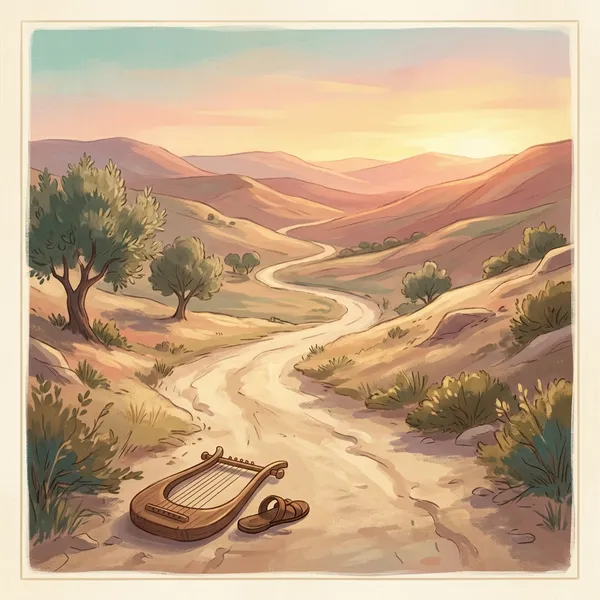
You have read a Bible story and felt something catch. A small recognition, like spotting your handwriting in someone else's notebook. Maybe it was David hiding in a cave after the oil had already been poured on his head. Maybe it was Hannah, year after year at the temple, praying through a silence that felt like it had her name on it. Maybe it was Joseph, dreaming of ruling his brothers and waking up in a pit.
That recognition is not a trick of the mind. It is one of the reasons the stories were preserved at all. If you have come here asking "which Bible character am I," you are already asking the right kind of question, because the answer tends to carry more than a personality label.
Why asking "which Bible character am I" is a serious question
There is a verse tucked into Romans that speaks directly to this. "For whatsoever things were written aforetime were written for our learning, that through patience and through comfort of the scriptures we might have hope." (Romans 15:4, ASV)
That word "learning" is doing real work. These were not written as trivia. They were written so that when you read them, something would click. Not information, but recognition. The people in those pages are long gone, but what moves them, what frightens them, what makes them reach toward God or pull back, that part is not old at all.
One preacher put it plainly: the Bible doesn't deify its main characters. Abraham lied to protect himself. Moses lost his temper so badly he cost himself the land he had spent forty years walking toward. David's years between the anointing and the throne included caves, exile, and sleeping on rocks. The Bible doesn't write these moments out. It writes them in.
Which means when you see yourself in one of these people, the point isn't that you found a personality type to pin to your chest. The point is that you are locating yourself inside a story where God was already present, already at work in the gap between what was promised and what had not yet arrived.
The characters who waited, and what their seasons teach
Not one of the waiting ones had a clean story. The season between the dream and the fulfillment was where they lived most of their lives, and it was where they became who they needed to be.
David was anointed king as a teenager. He wasn't sitting on a throne the next morning. The years after were spent playing harp for a king who then started throwing spears at him, living in caves, sleeping on rocks. One pastor described it this way: David had the map. He knew where he was going. Then Saul turned on him, and suddenly God seemed to have handed him a compass instead. He knew the direction but couldn't see around the next hill. What he never did was forget the promise. He kept it in his thoughts. And that retention, the act of holding on to what God said while everything contradicted it, was what made the caves endurable.
Joseph's delay ran even longer. The dreams came first. The pit, the slavery, the false accusation, the dungeon came second. The math adds up to more than twenty years between the dream and the morning his brothers bowed before him. In that dungeon, when a butler and a baker showed up with their own troubled dreams, Joseph could have looked at them and said, "I had a dream once. Look where it got me." He interpreted their dreams anyway. He served anyway. He kept a right heart in conditions that would corrode most people.
Hannah's story is shorter but not lighter. Year after year at the temple, praying for one son, not yet knowing what she was actually fighting for opened something larger than she had imagined. Her husband came to her one year and said, in effect, "Am I not better to you than ten children?" She loved him, I think, but she would not let go of what God had placed in her.
Then there is Abraham, waiting decades for the son God promised, and still producing his own backup plan in the form of Ishmael. The father of faith is also a man who got impatient and built a plan B. The Bible tells us that and keeps right on calling him faithful, because the larger arc of his trust held even when individual moments did not.
These are the Bible characters who waited. They are, most likely, who you will meet when you sit with the short quiz below.
Which character you land on isn't the end of the story
Knowing which character you resemble is a beginning, not a conclusion. If you see yourself in David, warm and loyal and given to extremes, prone to the heights and the caves in equal measure, that is worth knowing. But David did not stay the man sleeping on rocks with a price on his head.
If you see yourself in Joseph, the one told something about his future that nobody around him believed and that circumstances contradicted for years, that is worth knowing too. But Joseph did not stay in the dungeon. He came out with the capacity to feed a nation, including the brothers who had sold him.
The waiting season was not wasted time. The character formed in obscurity was the character that held up once the promise arrived. One conversation I came across made this point plainly: you cannot drive every giant out of the promised land on the first day, or there will not be enough of you left to make the land fruitful. The delay has a purpose, even when that purpose is not visible from inside it.
That is not a comfortable thing to hear when you are in the middle of it. I know. Proverbs 13:12 simply says that hope deferred makes the heart sick. The Bible does not pretend waiting is easy. It just keeps showing us people who waited well, and what happened to them on the other side.
When the silence feels personal
The hardest part of the waiting season, for most of these people, was not the outward difficulty. It was the inward question. What is wrong with me? Why is nothing moving? Did I imagine the whole thing?
Job never got a clean answer to why he suffered. Not in the book, anyway. He finished well, but he finished without closure. That is in the text for a reason.
What the stories offer is not an explanation of your timing. What they offer is company. You are not behind, and the article on the lie that you are falling behind goes deeper on exactly that pressure. You are not forgotten. You are somewhere in the middle of a story that has not finished yet, which is exactly where David was in the caves, exactly where Joseph was in the dungeon, exactly where Hannah was in the temple year after year.
The characters of scripture were not placed there to be ideals. They were placed there so you can see yourself in them, and then ask the more useful question: where did God take them from here?
Does God always make you wait years?
Not always. What the scriptures suggest is that God's timing is not accidental. The seasons between the promise and the fulfillment are not filler. They are where something is built inside of you that you will need later.
The question worth sitting with is not "how long will this take" but "what is this season forming in me?" David in the caves was becoming a king who knew what it felt like to be hunted. Joseph in the dungeon was developing the capacity to steward a nation's resources, which was exactly what his assignment required. The piece on what God may be preparing you for sits right alongside this theme if the waiting season is pressing on you.
You are already in the story. The character you see yourself in right now is not the final word on who you are.