Overcoming Comparison Before It Steals Your Peace
You were fine. You were actually fine. And then you opened your phone.
Maybe it was a friend's vacation photos, her standing in front of something golden while you sat in your kitchen in the same hoodie you've worn for three days. Maybe it was someone from your church posting about a ministry opportunity you quietly wanted for yourself. Overcoming comparison starts, oddly enough, with admitting the feeling was real. A sudden sense of being behind, a version of your life that looked smaller the second you measured it against someone else's.
That feeling has a name. The Bible calls it coveting. We call it scrolling.
The prison overcoming comparison starts by naming
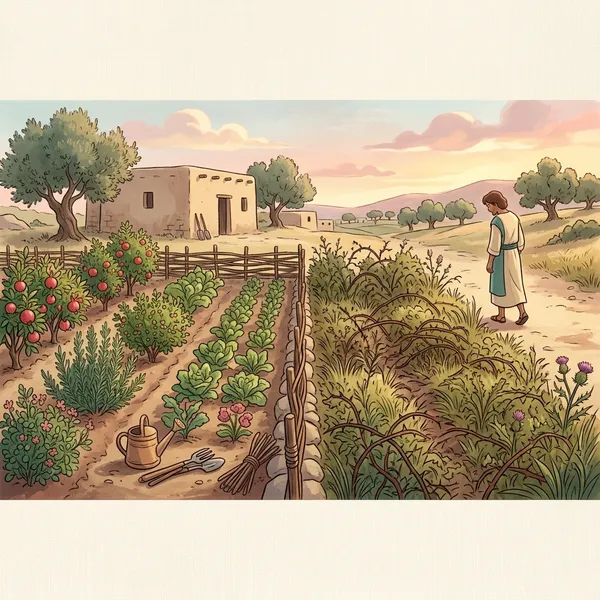
One preacher described comparison as a prison. The image stuck with me because prisons feel inescapable even when the door is unlocked. You can be sitting inside what God has given you, a life with real gifts and real grace in it, and feel completely trapped just because you can see through the bars to what someone else has. The trap does not require deprivation. It just requires a measuring stick.
What makes the measuring stick so cruel is that we almost never compare ourselves to the full, complicated truth of another person. We compare ourselves to the version they chose to show. You are comparing your ordinary Tuesday, your doubts and your dirty dishes and your slow progress, to their curated Saturday. You will lose that comparison every time, and the loss does not mean anything real, because the contest was never real.
I have done this with spiritual things too, which I am almost more embarrassed to admit. I have sat in church and felt something uncomfortable watching someone else pray with a fluency I did not have, or seen a friend step into a role I had been quietly hoping for, and felt the sting. Jealousy between Christians, between people who genuinely love each other, is not talked about enough. One podcast host put it plainly: she had been comparing her walk with God to her friends' walks, watching what God seemed to be doing through them, and feeling stuck in a season of nothing. The honesty of that was like a breath of air. Of course we do this. Of course.
What comparison in the Bible shows us about where this goes
The Bible does not handle comparison gently. It traces the line from jealousy to destruction with uncomfortable clarity.
Think about Saul watching David. Here was a king with victories behind him and a calling from God, and still he could not stand in the same room as a young man the crowds were celebrating. "Saul has killed his thousands, and David his ten thousands." One comparison, heard once. Saul spent the next years consumed by it. He lost his joy. He lost his judgment. He ended up throwing a spear at a teenager because something in him could not tolerate the celebrating. That is what comparison does when you let it run. It does not stay in your chest.
Joseph's brothers sold him into slavery. Cain killed Abel. The older son in the prodigal story stood outside the celebration, unable to go in, because his brother had received something he had not. Envy made the party inaudible to him. It will do the same to you, making good things invisible because you are too busy keeping a record of what you believe you deserve.
"But let each man prove his own work, and then shall he have his glorying in regard of himself alone, and not of his neighbor." (Galatians 6:4, ASV)
That verse is blunt in the best way. Your work. Your glorying. No one else's is in the equation.
Running your own race when comparison in the Bible reframes the whole contest
Here is something worth sitting with honestly: you were not given their gifts, their timing, or their specific assignment. So running their race is not ambition. It is, in a strange way, a form of ingratitude for what you actually are. If comparison has left you feeling like you are falling behind a schedule you never agreed to, that feeling is worth examining, because it usually has more to do with a borrowed measuring stick than a real one.
One teacher put it this way: God will never call you to do something that does not require him. The thing you feel weakest about, the place where you feel most outmatched by whoever you keep comparing yourself to, might be exactly where God intends to show up. Moses was carrying a shepherd's staff, a reminder of everything he had failed to become, and that became the instrument. God was not embarrassed by Moses's smallness. He used it.
Obedience is the measure, not visibility. A single mom raising children in the fear of the Lord is succeeding before God. There are unnamed heroes in the Bible whose impact is known where it matters. Your life does not have to look like what success is supposed to look like online.
This does not mean you stop caring about growth. Honest self-examination is good. The question is whether you measure yourself against your own calling or someone else's. Only one of those is useful.
The practical antidote nobody talks about enough
Here is what actually works, and I say this having heard it from more than one person who had clearly field-tested it: when you feel jealous of someone, bless them out loud.
Not because you feel like it. Because you do not feel like it, and that is the point.
One woman described doing exactly this: when jealousy started to take root toward someone she knew, she would call out the specific thing she was envious of and say something honoring about it directly. She would go out of her way to celebrate them. It sounds almost absurdly simple. But she said something true about what it does: it takes the power out. Jealousy needs secrecy to fester. Dragging it into the open, then actively blessing the person you resent, short-circuits something. The feeling does not always vanish, but it loses its grip.
Gratitude is part of it too, but not as a slogan. One woman described putting down her phone mid-scroll, looking around her room, and just starting to name things. The bed. The roof. The answered prayer she was already living inside of without noticing. Comparison needs you to look at what you lack. Gratitude insists you look at what you have. They cannot fully coexist.
The short quiz below can help you see which particular flavor of comparison tends to hook you most.
Does overcoming comparison mean never feeling envy again?
No. That is not the promise, and anyone telling you otherwise has not read the same people you are reading. What changes is not the feeling's arrival but what you do with it. Jealousy surfaces; the question is whether you let it fester into something that distorts your perception of other people and of God, or whether you bring it to the light quickly.
One woman shared something quietly devastating: she discovered years later that a family member had been behind her father's death, and the root of it was jealousy. She stood in that room looking for the anger and could not find it, because God had done enough work in her heart that she saw the person before she saw the offense. That is not a testimony about being emotionally unfazed. It is a testimony about what regular honesty with God, over years, actually does to a person.
You are not behind. You are not forgotten. What comparison has taken from you, attention to your actual life, presence in your actual season, gratitude for the things God has already placed in your hands, those can be returned. Not all at once. But steadily, one honest moment at a time. Who you are before God does not shrink because someone else is celebrated, and your identity in Christ holds even on your worst days.
Your race is yours. No one else was built to run it.