Biblical Rest Is Not a Reward You Have to Earn
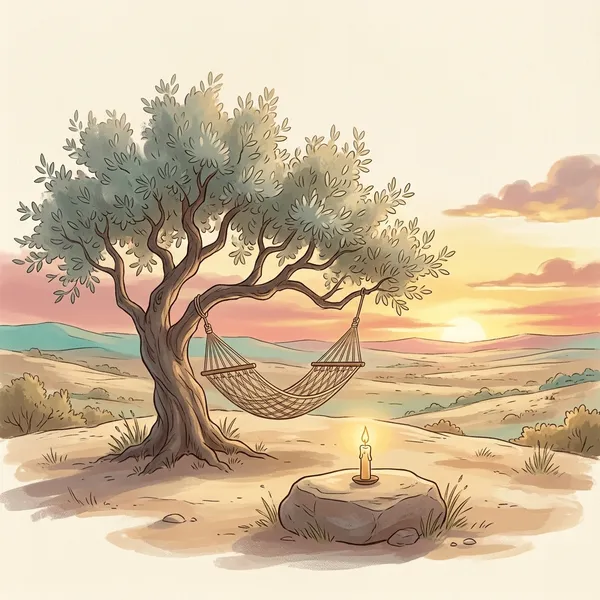
You know the feeling. You finally get a Saturday with nothing scheduled, and instead of feeling restored, you spend three hours scrolling your phone, then feel worse at the end of it than you did at the start. You were not working. But you were not resting either. There is a difference, and most of us have stopped noticing it.
A woman who leads a podcast about recovery and burnout described her pattern bluntly: she would go, go, go until she collapsed, then call the collapse rest. But it was not rest. It was the body quitting because no one gave it permission to stop earlier. If that pattern sounds familiar, the piece on what to do when you are running on empty speaks directly to it.
What the Bible actually says about biblical rest
Biblical rest begins in Genesis, before any law, before any of us arrived. On the seventh day, after creation was complete, God rested. Not because he was worn out. The work was finished, and rest was the fitting response to finished work. It was good in itself, not just a recovery strategy.
Rest is not the gap between productive seasons. It is a thing with its own weight and worth, built into the rhythm of creation from the beginning.
The Hebrew word behind that Genesis passage carries something surprising. It means to cease, to stop, to let a thing come to its end. One teacher who digs into word origins pointed out that the same root also carries the sense of destroying and removing. Which sounds alarming until you sit with it. When you genuinely rest, you are not just pausing. You are actively ending the cycle of striving, putting anxiety out of the room, dismantling the assumption that the world will fall apart if you stop pushing it.
Rest, in that sense, is an act. A small, quiet act of trust.
What does the Bible say about rest when life is not cooperating?
One of the hardest things about genuine rest is that it asks something of you precisely when you have nothing left to give. You do not get to rest first and then trust God later. The rest is the trust.
A preacher once said something that stayed with me: we judge God by our circumstances instead of by his character. When things are hard, the mind says God is absent. But the hard moment is exactly when his faithfulness matters most. He does not forget. He does not change.
"They that wait for Jehovah shall renew their strength; they shall mount up with wings as eagles; they shall run, and not be weary; they shall walk, and not faint." (Isaiah 40:31, ASV)
This is not a promise the difficulty will end quickly. It is a promise about what happens when you stop trying to carry it alone.
David had enemies who wanted to destroy him. Psalm 62 shows what that looked like from the inside. At the start of the psalm he declares that his soul finds rest in God alone. By verse five he is telling his soul to find rest in God alone. Somewhere between those two verses, fear and despair showed up and he had to fight for the thing he had already declared. That is not passive. That is one of the harder things a person can do.
Being still is not the same as being quiet
One voice in these conversations described her own restlessness honestly: she could pour out everything she wanted to say to God in prayer, and the moment he was about to respond, she would get up and leave the room. She did not realize she was doing it. She was filling every silence before it could be filled by something other than herself.
"Be still, and know that I am God." (Psalm 46:10, ASV) Another rendering puts it this way: surrender your anxiety, stop your striving, and you will see that I am God. The stillness is a posture of trust, not an absence of sound.
A lot of what we call rest is really numbing. Scrolling, overeating, staying up too late to carve out quiet minutes that do not end up quiet at all. These avoid the feeling of exhaustion without addressing what is underneath it. They cost you something without returning anything. The anxious striving underneath the busyness often needs its own attention before real stillness becomes possible.
Genuine rest has texture. It involves something outside the cycle of output and depletion. A walk without a destination. A meal with people you like, the kind where nobody checks a phone. Scripture without a goal. Prayer without an agenda. (I know that sounds impractical. It also sounds like exactly what you have been putting off.)
Jesus as our rest
"Come unto me, all ye that labor and are heavy laden, and I will give you rest." (Matthew 11:28, ASV)
There is a reason that invitation is extended to the laboring and the burdened rather than to the people who have finally finished everything. It is not a reward at the end of the to-do list. It is an offer made in the middle of the weight.
One woman described the moment she began to understand this. She had been a competitive athlete who made an unconscious vow never to fail, because the one time she had failed publicly, the people around her went cold. So she strived for years. The striving became a yoke that made everything harder. Then she came across a picture: paddling into strong wind versus turning around and letting the wind carry you. The yoke Jesus offers is a different direction. Not no effort, but effort aligned with something larger rather than grinding against it.
There is a place of rest, and it is in the presence of Jesus. That is not a metaphor. It is what changes when you stop trying to be indispensable.
The short quiz below can help you identify which kind of rest you are actually getting.
But am I allowed to rest before everything is done?
The answer is yes. And this is the point that keeps coming up whenever people who have actually wrestled with this talk honestly about it.
One speaker said something I have not been able to shake: rest is not what we do once we have completed all our tasks. We rest in the middle of all our tasks, without excuse and without guilt. The land in ancient Israel was commanded to rest. Animals were included in the Sabbath command. The rhythm of cessation was built into the whole created order, not just into human beings who had earned it.
You were not designed to be productive indefinitely. That is not a character flaw. It is how you were made. The command to rest is not a concession to your weakness.
Choosing rest is, in a small and daily way, an act of faith that someone else is holding what you are not holding. That the inbox will not determine whether God keeps his promises.
"Jehovah is faithful in all his words, and holy in all his works." (Psalm 145:13b, ASV)
He does not falter. He does not forget. You do not have to fill the silence to keep things running.
Can you actually learn to rest?
You can. It is a practice, not a switch. One person described starting with one-minute intervals of just sitting still, no phone, no music, and building up from there. Another described surrendering her calendar to God each morning and watching appointments clear on days when her body needed space. Another described sitting before God without an agenda, no Bible open, no journal, just listening, and finding that things that had felt impossible to hear started coming through.
None of these are dramatic. Real rest is not dramatic. It is quiet, repeated, until it becomes the place you live from rather than the thing you have to earn.
You are being invited into it now, not after you have finished enough.