How to Put On the Full Armor of God
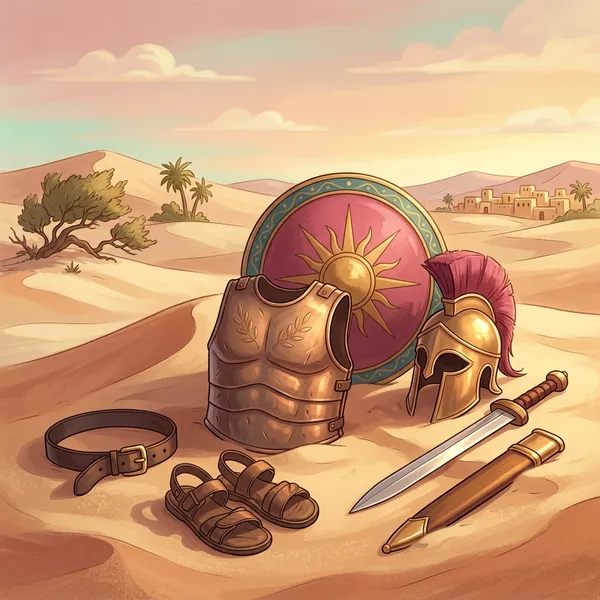
Some mornings the weight is already there before your feet hit the floor. An old accusation circling back. A conversation you are dreading. The low-level hum of a worry that never fully switches off. You have not done anything yet and it already feels like you are pushing against something.
Paul felt that pressure too. He wrote about it from prison, chained to a Roman soldier, watching the man's gear shift with every movement. And out of that small, cramped circumstance he gave us one of the most practical passages in the whole New Testament: "be strong in the Lord, and in the strength of his might." (Ephesians 6:10, ASV)
Not your strength. His.
What the armor of God is actually for
Before getting to the pieces themselves, it helps to read the goal Paul sets. He does not say "win" or "conquer" or "dominate." He says stand. Three times in a few verses, he comes back to that word. "Put on the whole armor of God, that ye may be able to stand against the wiles of the devil." (Ephesians 6:11, ASV) Then: "having done all, to stand." (Ephesians 6:13, ASV)
Standing firm. That is the aim. Still on your feet when the day is done.
He also names what we are actually fighting. "our wrestling is not against flesh and blood, but against the principalities, against the powers, against the world-rulers of this darkness." (Ephesians 6:12, ASV) That one line reframes a lot. The difficult person at work, the family member who keeps saying the wrong thing, the version of yourself you keep being disappointed in: none of those is the real enemy. When you forget that, you aim all your energy at people instead of standing in what God has given you. I have done this more times than I want to count.
The fight is real. But the target is spiritual, which means the response has to be spiritual too. Paul's answer is the full armor of God. Not a few favorite pieces. The whole thing.
The six pieces of the full armor of God, lived out on an ordinary day
The armor is not abstract theology. Each piece maps to something you can practice in real life.
The belt of truth holds everything else together. In the same way a soldier's belt secured his tunic and gave him a place to anchor his weapons, the truth of what God says about you secures everything else. The fights that knock people over most often start with a lie that went unexamined. The thought that you are too far gone, that you are beyond repair, that God has better things to do than pay attention to you. The belt means naming those thoughts and answering them: that is not the truth. The truth is what the word says, and the word says you are forgiven and known and kept.
The breastplate of righteousness covers the heart. One teacher I heard described the heart as the control center for your entire spiritual life (your thinking, your emotions, your conscience, your capacity to hear God's voice). If the enemy can land a clean shot to the heart, everything downstream goes sideways. The breastplate protects against that. Paul does not say this righteousness is something you manufacture. It is the righteousness of Christ, worn over the part of you most prone to shame. When the accusation comes (and it will), the breastplate is the reminder that you stand covered, not exposed.
The shoes are "the preparation of the gospel of peace." (Ephesians 6:15, ASV) This one confused me for a while. Why peace, in the middle of a fight? But a person at peace with God is hard to knock off balance. The shoes are not about aggression; they are about stability. Whatever ground you stand on today, you stand there in peace with God. That is steadier footing than most people walk on.
The shield of faith is the piece Paul spends the most words on. With it, "ye shall be able to quench all the fiery darts of the evil one." (Ephesians 6:16, ASV) The darts Paul means are those intrusive thoughts that arrive before you can choose them: the spike of fear, the wave of doubt, the accusation that lands at 2 a.m. and refuses to leave. Faith does not pretend the darts never came. It lifts something between you and them. If anxiety tends to be where your darts land, anxiety and faith can coexist sits right alongside this one.
The helmet of salvation guards the mind. Most of the battle is fought in the thought life, in what we let replay and what we refuse to rehearse. The helmet is the settled, resting knowledge that you are saved. The outcome of the war is not in question. You do not have to earn your way through each day; the question of where you stand before God has already been answered. Wearing that settled assurance changes what you let into the queue.
The sword of the Spirit is the only offensive piece Paul names, and he is specific about what it is: "the sword of the Spirit, which is the word of God." (Ephesians 6:17, ASV) This is how Jesus met his own temptation in the wilderness, not with willpower or argument, but with scripture spoken back. One verse, held and spoken in the moment of pressure, does more than an hour of trying harder. Learning to hear and hold that word is its own daily practice, and hearing God in a noisy world goes into that directly.
How to put on the armor of God daily
Here is where it stops being a beautiful metaphor and starts being something you can do before breakfast.
Paul does not end the passage with the six pieces. He adds one more thing: "with all prayer and supplication praying at all seasons in the Spirit." (Ephesians 6:18, ASV) The armor goes on in prayer. That is how it works. You do not think your way into wearing it; you pray your way into it.
That can be simple. A few minutes before the noise of the day starts. Naming the lie you are most likely to believe in the next twelve hours, and answering it with one thing that is true. Asking for peace before you have anything to feel peaceful about. Holding a verse in mind on the commute, in the waiting room, in the silence before the meeting.
None of this is about striving harder or generating more willpower. The armor was already issued. Your part is to put on what God has already provided. One preacher I heard put it simply: the goal was never to be a more impressive fighter. The goal is to still be standing when the day is over.
If you are not sure which piece you rely on most, or which one you tend to leave in the closet, take a moment with the short quiz below.
Is the armor of God symbolic or real?
It is a picture, and the picture points to realities that are not symbolic at all. There is no literal belt to buckle. But truth, the righteousness of Christ, peace with God, faith, the assurance of salvation, the word of God: those are as solid as anything. Paul used the soldier standing in front of him to make invisible things tangible. The armor was never about the costume.
It was about showing you that you are not walking into the day unarmed. The armor was issued before you woke up. You do not have to earn the right to wear it. You just put it on, and you stand.
That is enough. Some days, that is everything.